
If you are finding it difficult to move your arm or do basic work like lifting books or fetching kitchen utensils from the shelf, you might be suffering from a rotator cuff tear. Rotator cuffs are nothing but a relative family of tendons and muscles that help you do the basic shoulder movements. So, a tear occurs when tendons yield from your arm bone. But nothing to worry about because every medical issue has a treatment, right?
Of course, you will be diagnosed and based on that, your treatment will initiate, but you should know that the course of action will depend on the degree of tear. Subsequently, there are two modes of treatment processes- (a) traditional repair, (b) path augmentation.
In this article, we will take a deep dive into patch augmentation vs rotator cuff repair, and also unlock some insights that will help you make an informed decision.
Traditional Rotator Cuff Repair
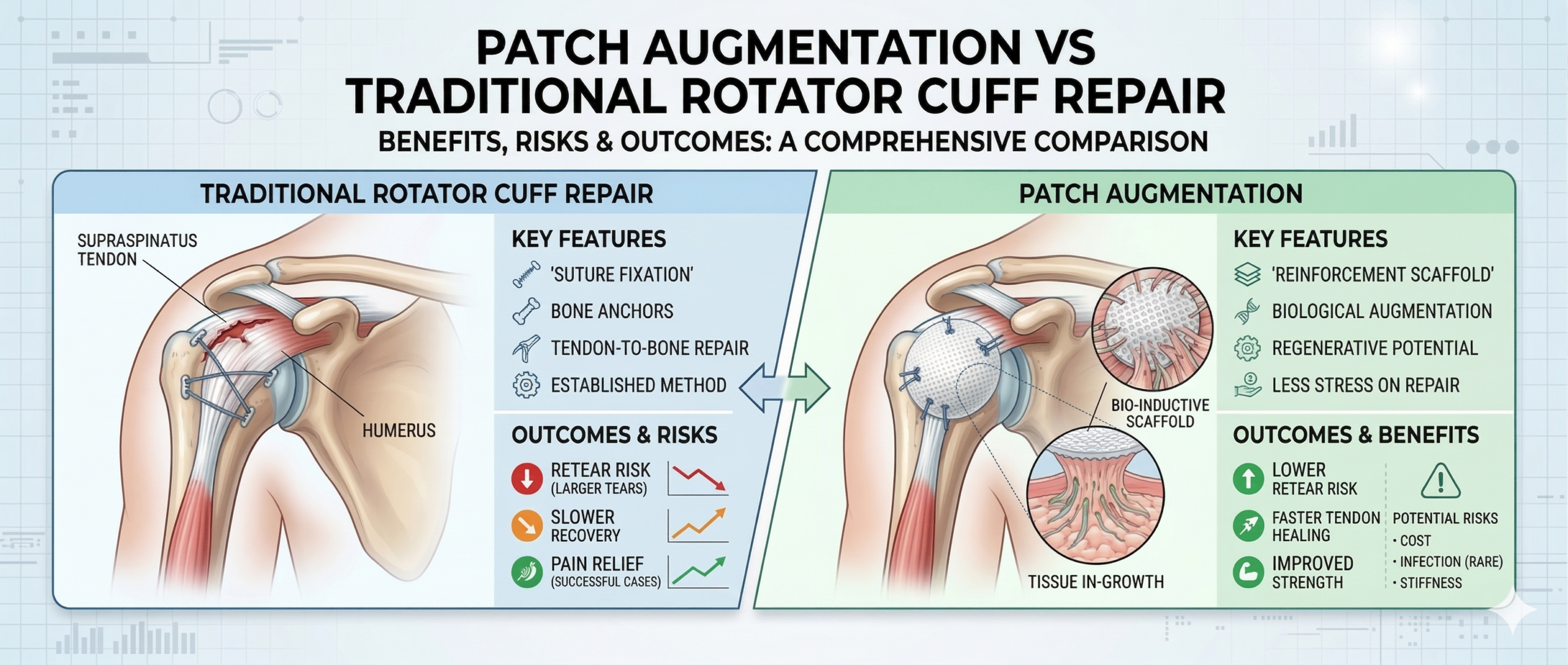
In this procedure, your surgeon will insert an arthroscope (micro camera) through a small incision in your shoulder. He or she refers to images derived from the camera to perform the procedure. Ultimately, your surgeon will implement sutures and an anchor to refasten the torn tendon directly back to the bone.
This methodology is best suited for:
● Minimal tears: Where the gap is manageable, and the tendon can be pulled back to the bone without excessive tension.
● Healthful tendon tissue: When your tissue is thick and strong enough to hold the sutures firmly.
The ultimatum of this procedure is to revive the original anatomy of your shoulder by allowing the tendon to heal naturally to the bone. And success is noted when the patient reports a full range of motion.
Patch Augmentation
It’s appropriate for conditions that need special support for the tendons. It basically involves fixing a biological or synthetic “scaffold” over the repaired tendon. Think of it as reinforcing an abraded segment of fabric with a robust backing to prevent it from tearing again.
Why this patch is incorporated:
● Extra Support: It provides mechanical strength to the repair site while your body works on biological healing.
● Healing Induction: Several modern patches act as a “bio-inductive” bridge, encouraging your body to grow new, healthy tissue into the patch.
This procedure is appropriate for:
● Substantial Tears: Patch augmentation success rate is high where the tendon has retracted significantly.
● Weak or Degenerated Tissue: Often seen in chronic tears or older patients, where the “meat” of the tendon is thin or frail.
Key Differences at a Glance
| Factor | Traditional Repair | Patch Augmentation |
| Tear Size | Best for small to medium tears. | Designed for big, substantial ones |
| Tissue Strength | Relies on your naturally strong tissue. | Supports weak or degenerated tissue, like in elders |
| Healing Support | Counts entirely on natural biological healing. | Offers enhanced “scaffold” support for amelioration. |
| Re-tear Risk | High, in case of big and sophisticated tears | Much lower due to added reinforcement. |
| Complexity | A standard, highly effective procedure. | An advanced technique requiring specialized skill. |
Benefits & Risks
Let’s look at the different rotator cuff surgery benefits and cons relatively:
(A) Traditional Operation
Advantage perspectives:
● Got a solid, proven track record, worldwide
● The procedure comes within the budget of many since a minimum number of specialized tools are needed.
● Quick procedure time under anesthesia for the patient.
Risk factors:
● In larger tears, the “failure rate” is higher because the tension on the sutures may be too great.
● If your tissue is as flimsy as tissue paper, traditional sutures may yield within a quick span of time.
(B) Patch Augmentation
The Edge:
● Imparts unmatched strength by incorporating a “belt and braces” approach to shoulder stability.
● Notably enhances the success rate for massive tears that were previously considered irreparable.
● Lower Re-issue: The patch distributes the load, safeguarding the repair during the vulnerable early healing phases.
Risk factors:
● Greater expenses: The specialized patch material adds to the overall surgical cost.
● Slightly longer surgery: It takes extra time for surgeons to precisely place and secure the patch.
● Needs mastery: This is an advanced procedure that should only be performed by surgeons experienced in bio-inductive technologies.
Outcomes & Recovery
Irrespective of the method chosen, the ultimate motive of your shoulder treatment should be to relieve you of your pain and restore strength.
How recovery looks like:
● Achieving comfort: Both methods are highly effective at reducing the chronic “night pain” associated with rotator cuff tears.
● Physiotherapy is a must: Whether you are treated with a patch or traditionally, your commitment to a structured rehab plan is the deciding factor to success.
● Timeline: Most patients spend 4–6 weeks in a sling, followed by several months of strengthening. While the patch may speed up biological “thickening” of the tendon, the physical therapy timeline remains similar to ensure the bone-to-tendon bond is robust.
Which Option Is Better for You?
Not every shoulder structure is the same, and neither is the condition of the rotator cuff tear of every patient. So, consider that your surgeon will recommend your treatment module based on:
1. The severity of the tear: MRI imaging will reveal the extent of the damage.
2. Status of your tissue: Often, decisions are made “on the table” once the surgeon can physically see the health of your tendons.
3. Lifestyle and age: The requirement of an athlete might only be satisfied by the extra patch, whereas a dormant patient can lead a happy life after a traditional one.
Start your Correct Shoulder Treatment Today
By now, you know what treatment is best for minimal and maximum rotator cuff tears. But ensure that you don’t take any action unless suggested by an orthopaedic doctor. It’s always better to identify your doctor and start the diagnosis as early as possible.
Any wrong step in your early treatment can cause long-term trouble and pain, so consult an expert at each step. If you are still sceptical about rotator cuff surgery risks, find the best surgeon in Mumbai through our platform at shoulderandkneeclinic.com.
FAQ
Not always. Many people do well with a standard rotator cuff repair, especially for smaller tears. Your doctor will suggest a patch only if your tendon needs extra support.
No, in most cases the surgery is done with small keyhole cuts. So the scars are tiny and usually fade with time.
You can start doing light activities in a few weeks, but full recovery takes a few months. Following your physiotherapy plan is really important.
Sometimes, yes especially if the tear is small. But bigger or complete tears usually need surgery to heal properly and avoid long-term problems.