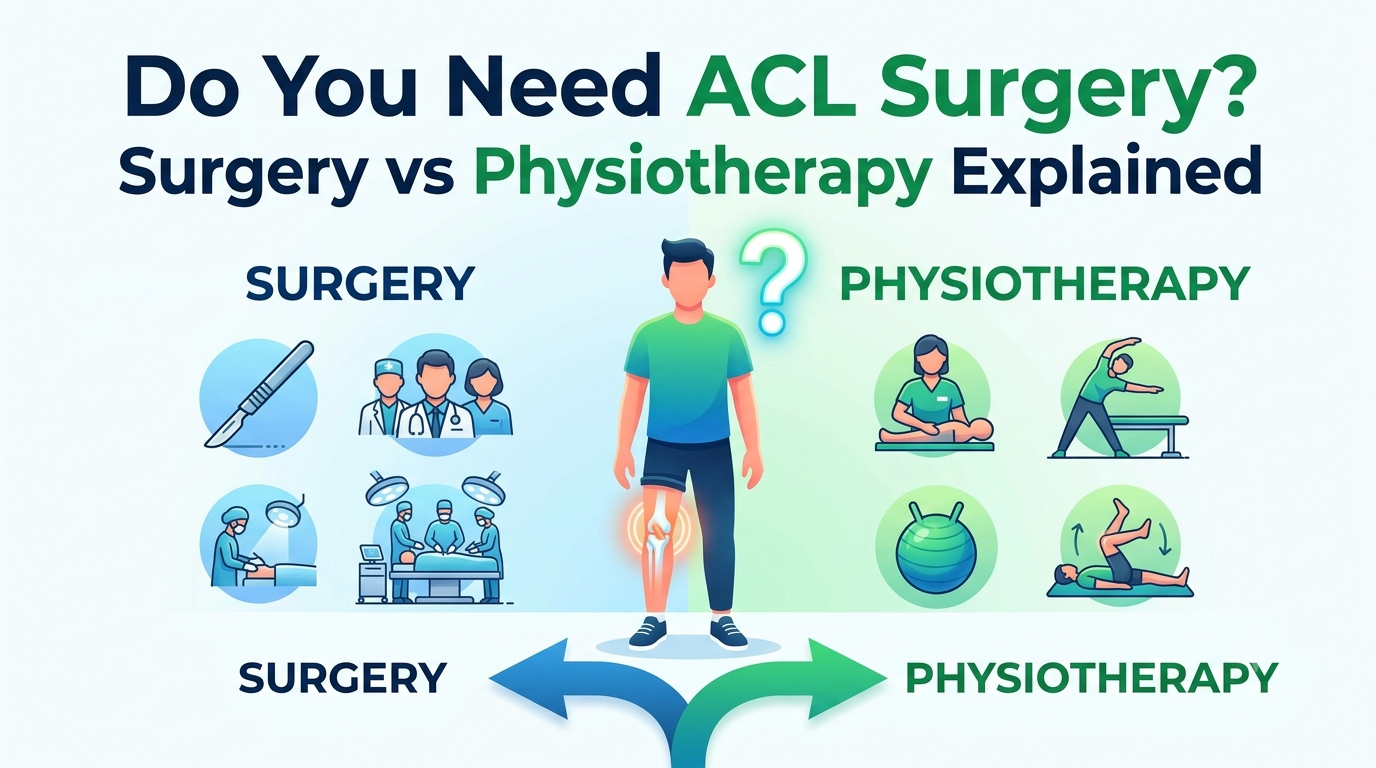
A torn anterior cruciate ligament or ACL is one of the most prevalent knee injuries sustained by athletes, sports lovers, and any physically active individuals. Since the ACL serves a vital role in stabilization, its injury can negatively impact mobility. Once diagnosed, the most prominent question most patients have: “Is surgery required or can physical therapy be enough?”
Making a choice between surgical reconstruction and non-surgical rehabilitation is a huge decision. There is no single perfect solution. The right treatment depends on different factors, such as the type of injury, your way of living, and your plans for the future.
What Follows After an ACL Tear?
It is beneficial to understand what the function of ACL is before knowing your options. This ligament is located in the middle of your knee and acts as the major stabilizing agent for the shinbone. It also offers rotational stability when the knee is taken in a different position. Once you have torn your ACL, this important system is disrupted and affects your everyday life or sports performance in the following way:
- Knee instability is characterized by the strange sensation of the knee giving way.
- Swelling, which results in the accumulation of fluid in the joint, limits movement.
- Problems with movements such as running, jumping, and altering position not as per normal.
Do You Need Surgery for this Ailment?
One of the most common misunderstandings is that a torn ACL always requires surgery. In fact, the need for an operation will depend on the individual. When assessing your knee, experts consider getting some clarifications around:
- Extent of the Tear : Has it just partially torn or has it ruptured fully?
- Functional Instability : Is your knee prone to giving way while performing daily or routine activities?
- Age and Activity Level : Young athletes often put more demands on their joints than older gamblers who hardly leave their couch.
- Sports Requirements : Do you play any cutting or pivoting sports such as soccer or basketball? Doctors are likely to recommend surgery for those who suffer from frequent deterioration of knee stability, as well as those who have concurrent injuries, and those requiring high-impact activities.
Treatment for ACL Damage Without Surgery
For many people, the non-operative route of treatment for an ACL tear is one of the most effective and successful methods. This option is usually applicable to individuals who experience only partial tears, those who do not experience instability during daily activities, or those individuals whose daily routine does not involve sharp turns. The non-surgical approach involves the use of the following treatment methods:
- Physical Therapy : A structured program aimed at reducing inflammation and returning to the full range of motion.
- Progressive Strength Training : Focused on the quadriceps and hamstrings to help them to take over the function of the overcome ligament and to stabilize the joint.
- Knee Stability and Proprioceptive Exercises : Exercises meant to retrain the brain and muscles to regain their ability to coordinate balance and position the joint.
- Modification of Activities : Giving up high-rotation sports for low-impact activities like swimming and cycling for a certain period of time or permanently. In case one decides on the non-surgical option, it is necessary to follow up regularly.
ACL Surgery vs Physiotherapy : Differentiating Between the Two
Knowing the differences between ACL surgery and physiotherapy can help you decide which method is suitable for your injury.
- ACL Surgery
During the procedure, the doctor usually repairs the ligament through reconstruction of the ACL, using graft tissue, which may be taken from your hamstring or patellar tendons. The surgery restores the operation of the knee after the injury. However, the surgery is just the beginning of a long rehabilitation process.
- Physiotherapy/Rehabilitation
On the other hand, physiotherapy does not require surgical intervention. The damaged ligament remains in its position. The rehabilitation process is aimed at strengthening the surrounding parts of the knee joint.
ACL Surgery vs Rehab: Which Option Is Better?
Since each patient has a different knee architecture, neither option is better than the other. Also, the category of injury might vary, among other factors. It is a recovery pathway that should be personalized and vetted with the right experts. One can only gather information regarding each methodology and have a basic understanding:
| Comparison Elements | ACL Surgery | Only Physiotherapy |
|---|---|---|
| Injury Seriousness | Typically chosen for complete ruptures or multi-ligament trauma. | Often successful for partial tears or isolated, stable injuries. |
| Knee Stability | Restores mechanical and structural stability inside the joint. | Depends on muscle power to offer necessary stability |
| Involvement in Sports | Commonly recommended for high-impact, pivoting, and versatile athletics. | Suitable for straight-line sports, running, and low-impact fitness. |
| Lifestyle Targets | To return to unrestricted, aggressive physical demands. | Focused on achieving pain-free, stable daily living and moderate exercise. |
Determining which category you fall into requires a comprehensive, specialist evaluation to assess the objective laxity of your joint alongside your subjective goals.
Treatment of ACL Tear without Surgery in Mumbai
If you would like to consider nonsurgical options in Mumbai, the first step is to have a correct clinical roadmap. The necessity of consulting an orthopedic surgeon cannot be emphasized enough. ACL tear treatment entails diagnostic examination in the presence of an experienced doctor and imaging techniques such as MRI to assess the condition of the ligament and surrounding tissues. After obtaining all this information, one is ready for the preparation of a specific recovery plan.
When Should You See an ACL Specialist?
You may want to consult with an ACL specialist when you notice any of the following concerning symptoms:
- Your knee feels unstable or weak with regard to common physical activities, like walking.
- You feel soreness or stiffness in your knee, even after light activity.
- Returning to your normal workouts after your injury has become a struggle.
- Persistent pain or lack of confidence prevents you from living the life you want to.
Final Takeaway
Experiencing an ACL tear doesn’t mean one has to sacrifice their career in sports or lead a below-average life. There are effective treatment options, and it depends on the physical demands and goals after recovery.
It is always recommended to go for an expert diagnosis at an early stage, rather than ignoring it for long. It might have adverse effects otherwise. So, if you are still asking the general questions to yourself, book an appointment with the best orthopaedic surgeons in Mumbai at shoulderandkneeclinic.com .