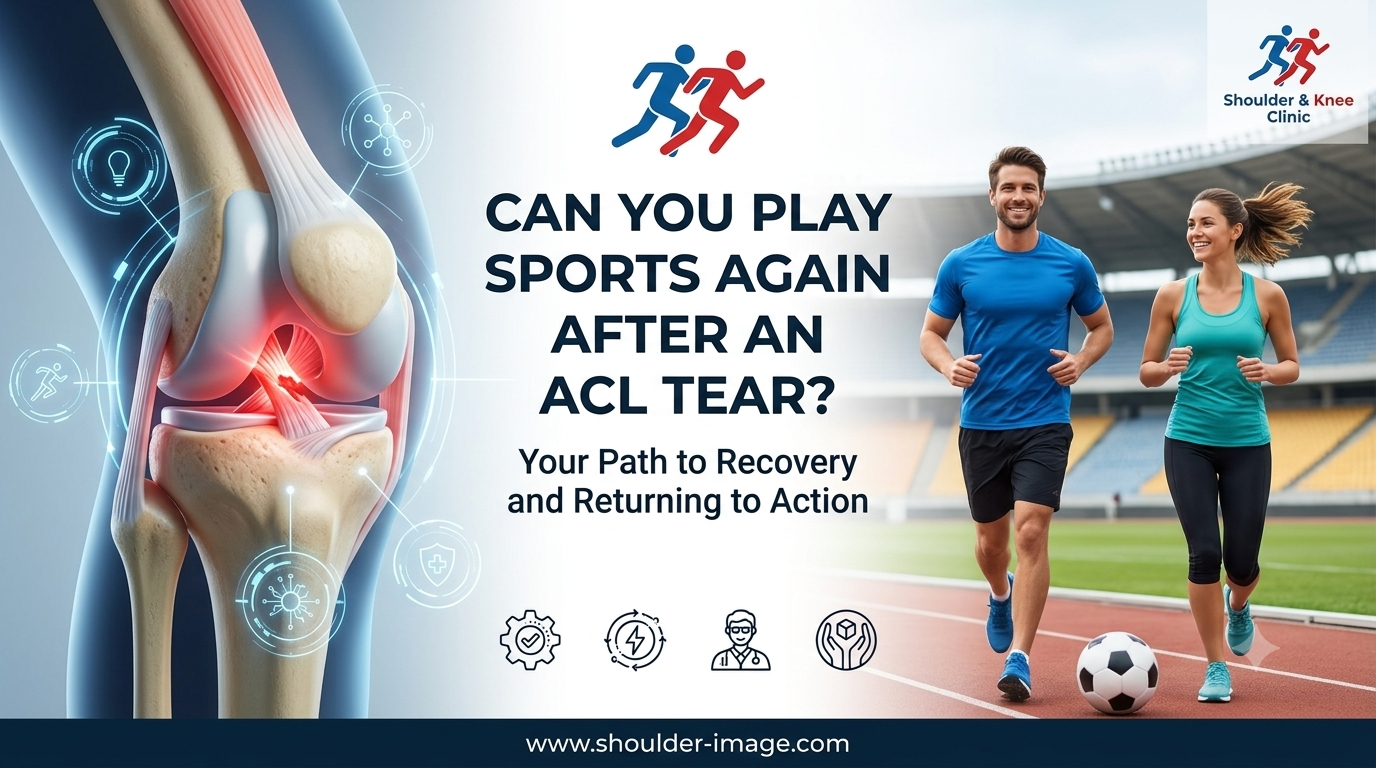
This knee ailment is devastating news for many athletes and sports persons out there, but it is the most common one after all. Beyond the immediate knee pain, one gets anxiety related to the loss of ability to play the sport or continue with the athletics one loves.
ACL happens to be a substantial part of the human body that helps maintain the knee’s ability to move during physical and daily activities. Subsequently, it is an important ligament running in the middle of the knee joint. Its principal function is to ensure stability of the knee joint and to restrict the forward movement of the shinbone when it slides away from the thighbone. So, it does play a crucial part in moving your knee, making sure it can rotate and twist from side to side.
A tear of the ACL doesn’t have to be career-ending for athletes. One needs to understand that a successful recovery depends on the depth of it, the treatment path they opt for, and the patient’s dedication to a structured rehab program.
What Follows After an ACL Tear?
To fully comprehend how to recover from the injury, one needs to grasp the role of the ACL, which we discussed earlier. When a person tears the ligament, they lose the main stabilizing element in the knee. Post ACL tear, the person will typically have to face a number of immediate and long-term troubles:
- Knee Instability : The knee will feel “unstable” during the moves, especially when changing direction.
- Swelling and Pain : The process of inflammation will start almost immediately after the injury, making any kind of motion difficult.
- Functional Limitations : Basic athletic movements, such as running, jumping, and changing direction, will become impossible.
Possible to Return to Sports Again After an ACL Tear?
The answer to this is just simply “yes.” A number of athletes succeed in getting back to sports after having an ACL injury. The advancements in sports medicine and the rehabilitation industry have made it easier to fully recover from an injury. However, the passage of time doesn’t guarantee a safe return to sports. The possibility of going back to sports depends on the following key aspects:
- Severity and Type of Injury : Partial injuries may be treated differently from total ruptures, where the meniscus is also torn.
- Treatment method : Your decision to get surgical repair or choose conservative treatment impacts the way your knee will operate going forward.
- Strength and Stability : Your overall muscle strength, especially in the thighs, must be good enough to support the change in the mechanics of the joint.
- Attitude towards Treatment : Making a comeback in sports means following a strict physical therapy program in the long run, which is impossible to accomplish without some commitment.
Duration It Takes to Return to Sports After ACL Tear
The duration of the recovery process is very individual and varies from one athlete to another. The timing of your return is not a fixed date. In the past, the doctors specified timeframes like “6 months” or “9 months,” but the recent approaches stress the outcome of your rehabilitation process.
Before proceeding with the next step in the rehabilitation process, the athlete should make sure he/she has completed the previous stage. This is very important for the safe return to sports after a knee injury: the knee must recover to a level that provides for the outstanding strength of the knee joint.
If an athlete has returned to sports at the time when the graft has not healed yet, or the muscles haven’t recovered sufficiently, there is a great risk of re-injury.
ACL Tear Treatment: Surgery vs. Rehabilitation
The choice of treatment is very personal and will affect how you will recuperate from your specific sport.
- When Physiotherapy is an Adequate Option
For individuals involved in non-impact and non-pivoting sports (swimming, cycling, straight-line running), rehabilitation physiotherapy without surgery can be a feasible choice.
- When ACL Reconstruction is Advised
For those wishing to participate in twisting, turning, and heavy-impact sports such as football, basketball, cricket, or tennis, the procedure of ACL reconstruction is usually recommended, where the damaged ligament is substituted with tissues taken from another part of the body.
Your choice of treatment affects the way you recover from sports. While rehabilitation in the absence of surgery is quicker, surgical intervention gives greater stability, crucial for intense multidirectional movement during sports.
Key Steps to Recover ACL for Athletes
In order to return to the game safely after being treated in the outpatient clinic, the recovery process must be carefully organized according to:
- Working on Strengthening of Your Knee : Initial steps begin with fighting swelling, achieving a full range of motion of your knee, and awakening and strengthening hamstrings, quadriceps and gluteus muscles.
- Building Knee Stability : This stage is related to neuromuscular exercises and proprioception training, which help you stabilize the joint during all dynamic movements.
- Training in Sport : You should practice all sport-related exercises prior to playing a game, which include pivoting on a spot, jumping and landing, as well as accelerating, according to the instructions of a physical therapist.
- Final Transition into the Game : You need to proceed to taking part in non-contact training first before continuing to full-contact training and playing the games.
When Can You Resume Sports After ACL Operation?
To play sports, you must obtain formal approval from experts rather than relying on your improvement post-surgery. Your knee doctor and rehab professional will assess several criteria based on their observations. Among the essential criteria, the following may be mentioned:
- Strength in Lower Limb : You should have good advanced strength of your quadriceps and hamstrings on the injured side, which means strength of at least 90% comparing to the non-injured side.
- Range of Motion : The knee joint should be able to flex and extend fully without discomfort.
- Dynamic Stability Testing : You must pass various sorts of movements and functional tests, such as the one-legged jump test.
- Mental Readiness : You should feel psychologically prepared, as fear of re-injury could hinder your motion patterns and diminish sports performance.
Can You Prevent Another ACL Injury?
After returning to your usual sport, taking care of the condition of your knees becomes your utmost priority. Prevention of subsequent ACL injuries involves permanent monitoring of the condition of your knees.
It should first be remembered that a stable set of lower-body and core-strengthening exercises has to be carried out after finishing the course of physical therapy. This includes the use of various warming up practices, like dynamic stretches and agility drills, as well as training of correct motor patterns, which means proper landing (with knees positioned in correct way). Adhering to educational exercise programs lowers the chances of repeating the same injury.
When to Consult an ACL Specialist?
When it comes to an injury of the knee, you might feel unsure of what to do, but there are a few warning signs that indicate the necessity of a professional examination:
- Constant knee instability accompanied by a feeling that the joint is loose when performing daily activities.
- Frequent swelling or pain that occurs even after minor physical activity.
- Trouble with simple movements or in returning to normal life activities.
- The need for an effective treatment plan that will be tailored to suit your athletic objectives.
Final Takeaway
Experiencing an ACL injury is not only painful but also brings a lot of anxiety to athletes. The good news is that one doesn’t need to end their sporty spirits there.
All it takes is the right pathway towards full recovery and subsequent rehabilitation. With the right guidance of the orthopaedic surgeon and experts, a person can return to their sports gradually.
If you are still wondering about the best path to your ACL recovery, book a consultation with the best orthopaedic surgeon in Mumbai today at shoulderandkneeclinic.com.