
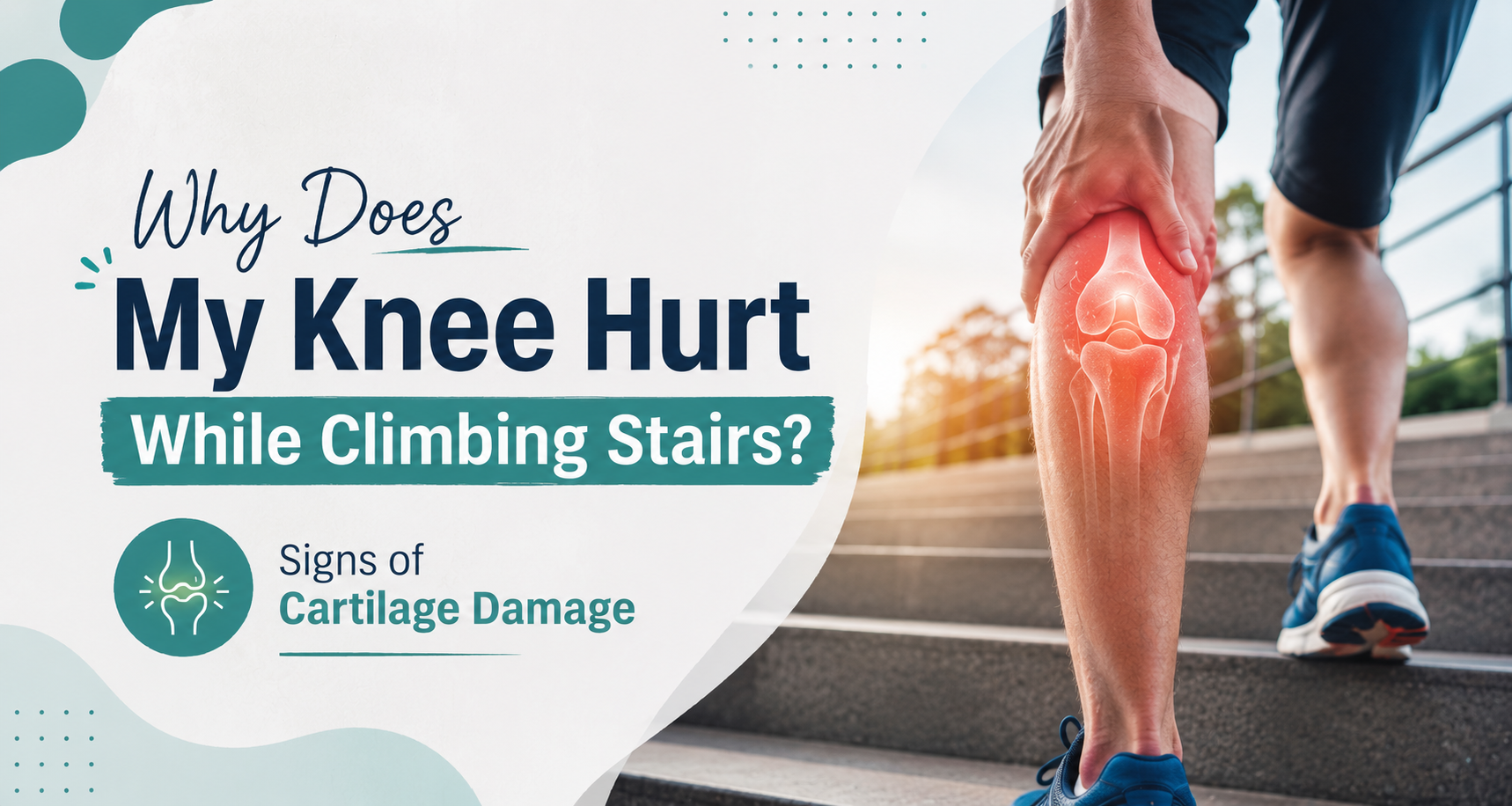
See, if you are experiencing knee pain while climbing stairs, it means there is an underlying issue that is not normal. And no, it’s not always due to old age. Often times its is about knee cartilage damage, which doesn’t heal on its own and can turn chronic if you don’t address it timely.
Today, it might be just about climbing the stairs, tomorrow you might feel a sharp twinge while walking on an uneven road. So, yes, your knee cartilage issue will gradually affect your lifestyle, wherein you will feel increased pain, swelling, or even locking of your knee.
But don’t worry, as in this article, we will double down on the issues and also the effective solutions, which can help you get set on the right treatment path.
What Entails Knee Cartilage and Why Is It Crucial?
This is an active part of our inner body, which is a flexible and connective tissue that safeguards our bones and joints. It acts as a shock absorber across our body, including our knees. In other times, it allows the shin (tibia) bone and thigh bone (i.e., femur) to glide over one another, seamlessly. These conditions highlight that it is an integral part of our regular mobility.
Now it can get damaged due to trauma such as a pivoting sport or when turning the knee in a wrongly manner. It can also come loose due to damage in the underlying bone, OCD, or osteonecrosis. So, the next time your knee hurts going upstairs, think about it for a moment.
What happens when cartilage is damaged?
Since knee cartilage is not related to any blood vessels, it takes a lot of time to repair itself in case of any significant damage. Now, when left unattended for a long time, the patient experiences certain symptoms, which will be discussed later in depth.
In other words, the cartilage suffers a chondral injury, a kind of tear, which makes the smooth surface rough. This enhances the friction where bone begins to rub more directly against adjacent bones. Ultimately, this leads to a substantial inflammation within your knee architecture, which the body indicates in the form of swelling, heat, and pain.
Why Does Knee Pain Get Worse While Climbing Stairs?
If you have recently experienced knee cartilage damage, then walking on a plain road won’t be an issue now. But the moment you climb stairs, you start experiencing an excruciating pain.
Now, picture the mechanism- your knee is subjected to a significant increase in mechanical load while you climb. Mathematically, just walking on a smooth street applies 1.5 times your body weight on your knees. And when it’s about climbing stairs, it is about 3 or 4 times your body weight.
Particular factors which comes into the situation:
- Patellofemoral Stress: Most stair-related pain occurs behind the kneecap (patella). As you bend your knee to lift yourself to the next step, the kneecap is compressed forcefully against the groove in the thigh bone. If the cartilage under the kneecap is thinning, this compression causes immediate pain.
- The Extent of the Bend: Stairs require a deeper range of motion than standard walking. The more the knee bends under load, the more stress is placed on the damaged areas of the cartilage.
- Case of Deceleration: Interestingly, many patients find going down stairs even more painful. This is because your muscles and joints must work harder to control the descent, putting intense “eccentric” load on the cartilage.
Common Knee Cartilage Damage Symptoms
Its vital to identify certain symptoms in the initial days to prevent further degradation of the tissue. Pain itself is not the sole identification factor; so, you should watch out for:
- Pain on front of knee when bending, particularly around or under the kneecap.
- Activity-driven pain, where you experience discomfort when climbing up or descending the stairs.
- The “Theater Sign”: Stiffness or aching in the knee after sitting for long periods (such as in a movie hall or during a long flight).
- Grinding or Clicking: A “crunching” sensation (crepitus) when you bend or straighten your leg.
- The knee may look “puffy” or feel tight post an activity-heavy day.
- Deep lunges or squats become nearly impossible without sharp pain.
When Should You Be Concerned About Knee Pain?
Although experiencing some knee pain while climbing stairs can be anyone’s call, there are certain “red flags” that substantiate its seriousness:
1. Your knee continues to ache for three days straight, even with rest.
2. You are avoiding using stairs completely, or only taking them one at a time.
3. Mechanical Symptoms: Your knee has a sensation of “catching” or “locking” or feels unstable, and you are unable to tell if it will continue supporting you when you change direction.
4. Increased Intensity: You now feel the symptoms moving from being an ache to having a stinging type of feeling, isolated to one area in your joint.
Treatment Options for Knee Cartilage Pain
The aim of treatment is to minimize swelling, enhance the function of joints, and maintain a significant amount of cartilage that is still available for use.
Conservative Management:
If there has been slight to moderate degeneration, then non-invasive treatments are generally very successful:
- Activity Modification: Replace high-impact forms of exercise (such as running) with lower-impact forms (such as swimming or biking) to help reduce stress on the cartilage.
- Physiotherapy: Building up the strength of your quadriceps and hamstrings is crucial, as having well-developed muscles can provide additional stabilization of the joint and lighten the load on the joint itself.
- Weight optimization can significantly lower stress on your knee cartilage while doing regular activities.
Advanced and Surgical Options
In the event that conservative options do not deliver positive results, contemporary orthopaedics has a number of different avenues for preserving joints, such as:
- Knee Arthroscopy- which is a less invasive method of cleaning up pieces of loose or damaged cartilage, or smoothing out rough surfaces of the joint.
- Cartilage Mending- procedures such as Microfracture or Autologous Chondrocytes Implantations (ACI); designed to produce new growth similar to cartilage tissue.
- Joint Preservation Surgery- realignment (osteotomy) that will transfer weight away from the injured portion of the knee to the healthy side of the knee, thereby delaying the need to have a total knee replacement.
Final Takeaway
Yes, feeling a painful sensation while climbing up the stairs can be an initial sign of your knee cartilage damage. But you never know the extent of it.
A proper diagnosis, inclusive of MRI scans or, in severe cases, arthroscopy, can significantly help you and your orthopaedic doctor to study and decide on the treatment path. So, it’s always better to have your knee checked up, especially when the pain is persisting for quite some days.
Take a step towards healthy living today by taking care of your knee condition; book the top orthopaedic surgeon in Mumbai today on shoulderandkneeclinic.com.