
If you think about it, our knees play the most crucial role when it comes to our mobility. It’s used for simple activities like walking, sprinting in sports, or even when we lift weights at the gym .
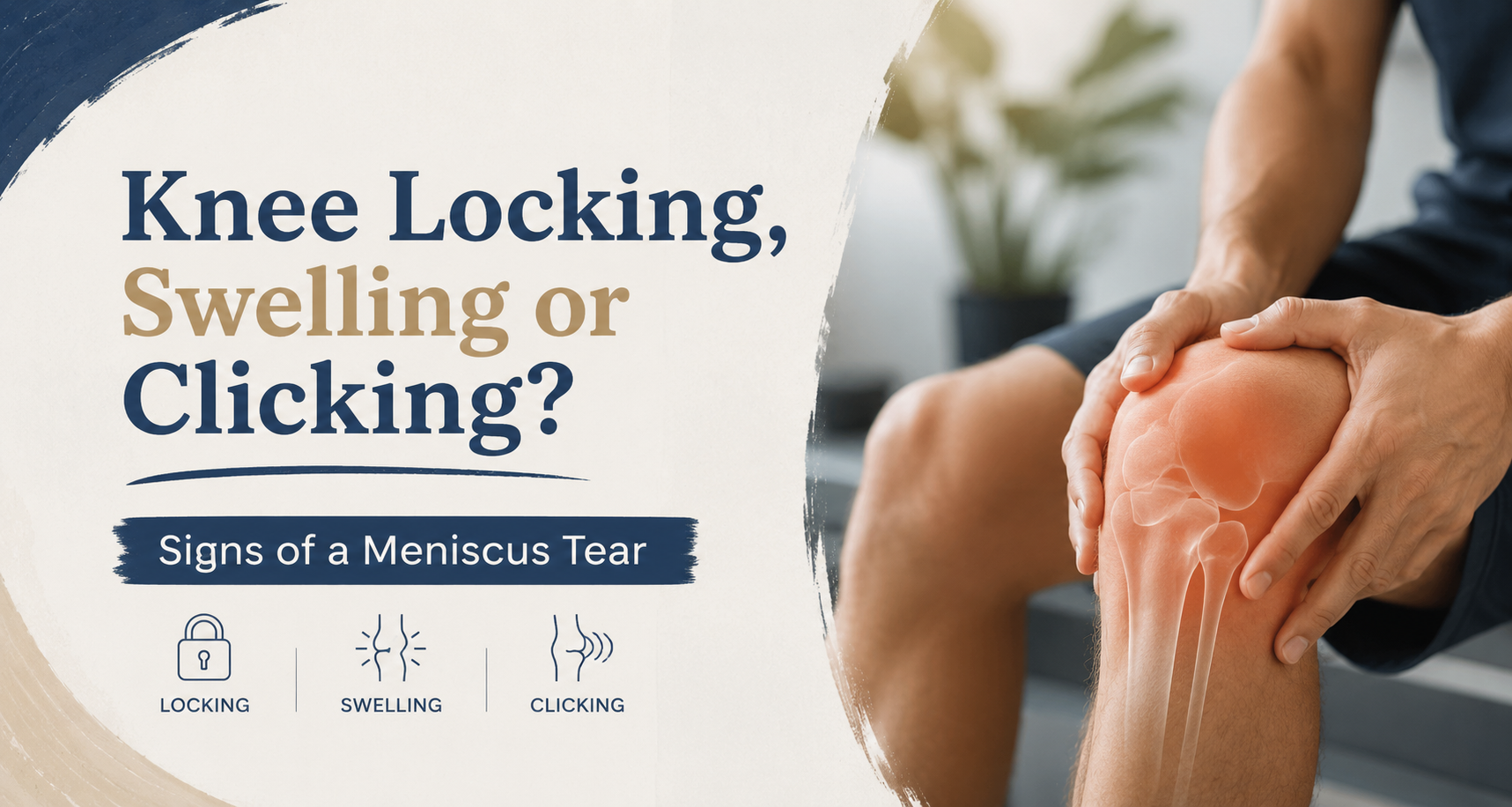
Now, during these moderate to intensive activities, people tend to twist their knees. Some may complain of sudden knee locking, some face swelling, and others hear a clicking sound or, worst, are unable to move it at all. In most cases, it might be due to the cause of a meniscus tear.
Now, the next question would be- what is it? What are the typical meniscus tear symptoms? And there are subsequent questions that fall into place like- does it happen only to the elderly, or does it need surgery?
Well, we will get into the depth of this knee ailment. So, keep reading.
What Entails Meniscus Tear?
To understand this particular damage, one must first comprehend the ‘behind the scenes’ of the knees. Inside them, the meniscus is a C-shaped piece of tough, rubbery cartilage that acts as a genuine shock absorber between your thighbone (femur) and shinbone (tibia). Note that every knee has two menisci: one positioned inside (medial) and the other on the outer end (lateral).
And yes, it can get torn if all of a sudden it goes through a hard twist or rotational movement. There are two types of tears named medial and lateral, which affect the respective cartilages that were described above; hence the name.
You also need to understand that these occur mainly during sports. So, athletes are more prone to this kind of knee ailment due to trauma. Apart from that, aged people also suffer from the same, and those with arthritis.
Generic Indications of a Meniscus Tear
Right after the tear, most people don’t face serious trouble with their knee. In fact, some of them still continue to walk or play sports, until they start facing trouble with symptoms in around 24 to 48 hours. Interesting, isn’t it?
Here are some key hints to watch your knee condition:
● One of the prominent signs can be when you can’t straighten knee, or it feels jammed
● Some kind of pop or click can be felt during basic movements
● Swelling can be another sign
● Uneasiness or pain during rotating or twisting your knee
● You might feel that your knee is yielding/giving away
Why Does Knee Locking Happen?
This locking condition of the knee can deteriorate your lifestyle drastically. The reason this happens is because of the structural damage to the knee mechanism caused by the tear. When the meniscus ruptures, a small segment or ‘flap’ of the cartilage gets swollen apart.
And just when you move your knee, this out-of-place flap becomes displaced and gets caught in the hinge of the joint. It’s like a pen got mistakenly stuck in the hinge of a door. So, when this occurs:
● The joint fails to complete its regular rotational movement
● It feels stuck in one place in a semi-flexed position.
● An implemented extra push can make it very painful as the fragment is pinched further.
In special cases, the locking happens temporarily as the flap moves back into place. But if the fragment remains lodged, the locking can become persistent, needing manual or surgical intervention.
When Should You Contact a Knee Specialist?
Look, one can obviously treat their meniscus tear condition via the R.I.C.E. method at home. This includes taking ample rest, using crutches, giving ice packs for 15 mins at a time (3 or 4 times a day), etc.
Even with these treatments, you see that your knee pain is getting worse (persistent swelling, frequent knee locking, and rise in pain), then it’s time to consult an orthopaedic expert.
Diagnosis and Treatment Options
When you reach out to a genuine orthopaedic expert, he or she performs specific clinical tests like McMurray, where the knee is rotated to check for pain points or clicking. These are done just to confirm the signs of meniscus tear.
Next, to confirm the size and position of the tear, an MRI will be recommended to get a clear image of the soft tissues that X-rays cannot see.
Now, if you are the patient, you have to understand that the treatment steps would be based on the location and severity of your tear:
● First, we already talked about how the R.I.C.E. protocol is implemented, which comprises Rest, Ice, Compression, and Elevation.
● Secondly, strength training and relative exercises are recommended to support the muscles (particularly hamstrings and quadriceps) to take the pressure off the injured joint.
● And lastly, if the seriousness of the tear is grave, unstable, or causing mechanical locking, a minimally invasive procedure known as Knee Arthroscopy might be suggested. In that case, surgeons can either perform a meniscus repair (bringing the pieces back together) or a meniscectomy (where the flap is removed).
Final Takeaways
There is no doubt that our knees play a huge role in our day-to-day mobility. Even a bit of discomfort can cause havoc in our lifestyle. You now understand that because the meniscus safeguards the bone surfaces, an impaired meniscus can accelerate the onset of osteoarthritis.
So, it’s always better to identify and treat the issue at an early stage. This, in turn, will help you return to your regular activities quickly. Always remember that a mere identification of meniscus tear symptoms doesn’t justify the same, and it is always better to consult consult an expert at shoulder & knee clinic.