
ACL knee injuries are more prone to athletes who venture in sports. These professionals sometimes take sharp turns in the field, which affects their knee structure. At first, it won’t seem like a big deal. But over time, it will highlight symptoms like swelling, redness, and yielding.
After you are diagnosed with an ACL (Anterior Cruciate Ligament) tear, most patients ask about the recovery timeline and how it progresses. You should know that the recovery period varies depending on factors such as the level of injury, the individual, and the treatment procedure.
Let’s take a deep dive into this particular injury, which will also include insights of its recovery timeline.
What Is an ACL Tear?
To comprehend your healing process, it is useful to understand the specifics of what happened to your knee joint. Your knee framework is inclusive of an ACL (at center), which is a tough & fibrous tissue that connects the femur (upper leg bone) to the tibia (lower leg bone). It serves as a support for structural stability for your knees by not allowing the tibia to slide forward off of the femur.
In most cases, an ACL tear can occur through non-contact activities when there is an abrupt halt combined with twisting/jerking movements, irregular landings from jumps, and/or being impacted by another player. An ACL will sustain damage when it becomes overstretched, thus causing injury through excessive force.
In general, orthopedic specialists classify issues into major categories:
- Partial ACL Tear : The fibers of the partially torn ligament remain intact and can provide some level of structural support for the knee.
- Complete ACL Tear : The ligament completely tears, resulting in two pieces of bone from the ligament being completely removed from each other.
ACL Tear Recovery Time: What to Expect
Due to the seriousness of your tear and how you go about healing it impacts your timeline significantly. A completely torn ACL has virtually no natural blood supply and therefore will not be able to heal itself or reattach spontaneously. Based on the total amount of structural stability as well as how much activity you intend to engage in, your pathway going forward will differ. For someone who has a partial tear and is not going to perform high-impact actions, the possibility of managing through a non-surgical option may be the preferred route; this type of pathway would double down on rehabilitation to strengthen the surrounding muscles.
If you have a complete tear and have persistent giving way of the knee, ACL reconstruction surgery is normally the option that is recommended, wherein tissue grating is done by the surgeon.
How Long Does an ACL Tear Take to Heal?
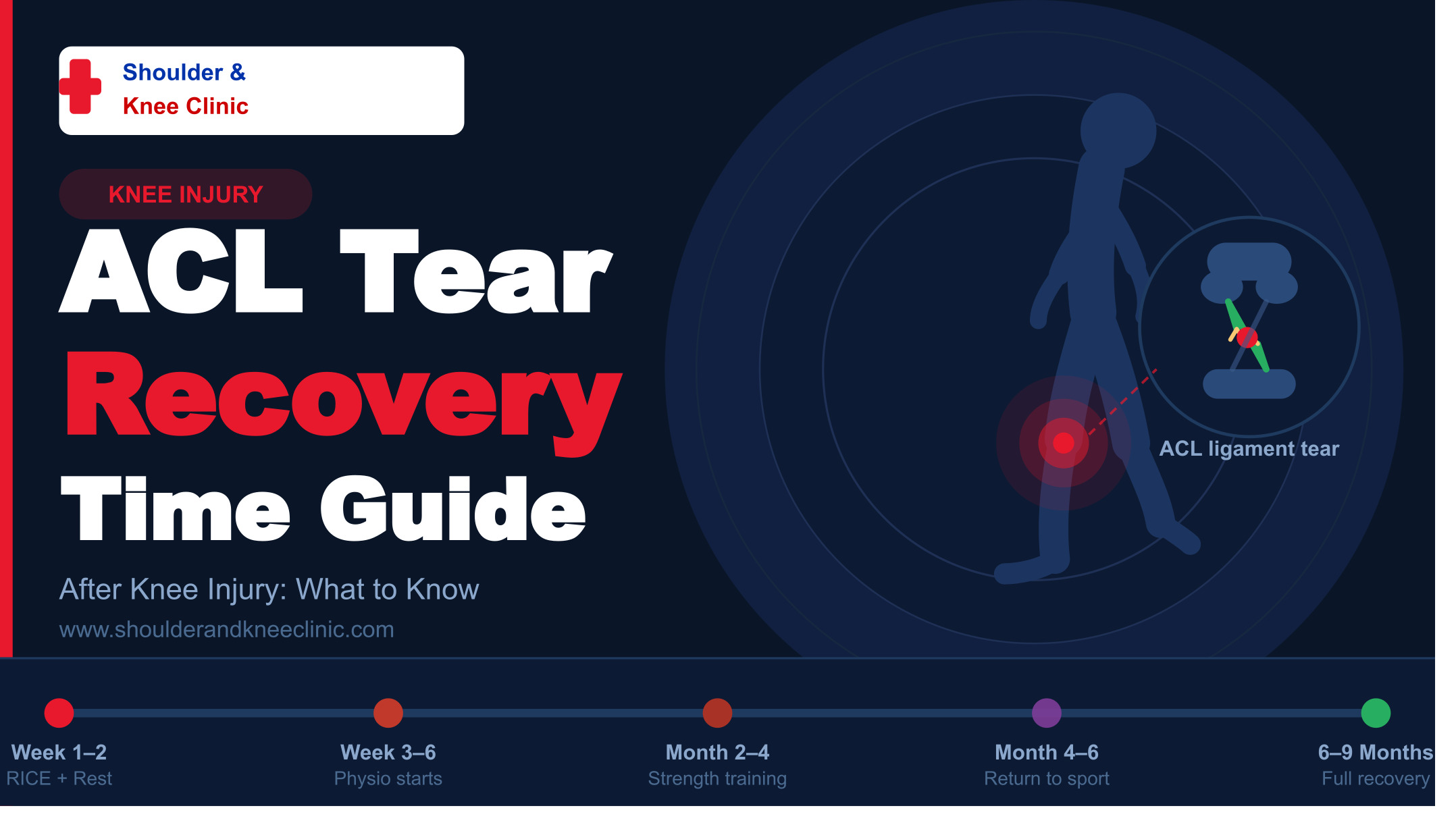
You need to recognize that healing from an ACL injury isn’t a quick experience. Whether treated with surgery or conservatively (non-surgically), the body necessitates time to remodel its tissue and rebuild its neurological control. A generalized timeline for what you will experience while recovering encompasses:
- The first two weeks will be spent on controlling pain, minimizing acute swelling, and restoring basic straight-leg extension.
- As you move into weeks three through six, you will gradually restore full knee flexion and work to wean off crutches and braces.
- As you progress from month two to four, your focus will be on building significant muscle (quadriceps and hamstrings) and low-impact exercises.
- The fifth month is about specialized training in the sport at which you will eventually return to agility drills, and monitored resumption of unrestricted athletic participation.
Note that the primary leader of this progression is the execution of thorough physiotherapy.
Knee Injury ACL : Treatment and Recovery Impact
The decision your surgeon recommends will affect how quickly you heal. Non-surgical, conservative management can usually enable you to function in daily activities between three and six months following your injury, but the knee joint may always be at risk of issues arising from high-velocity twisting forces. On the other hand, if a surgical reconstruction is performed, you will undergo a lengthy healing process where it may take six to nine months for your newly implanted graft to biologically integrate with your bone.
This is why it is so critically important to obtain an early, accurate diagnosis. By seeking treatment from an expert immediately following your injury, you will receive correct assessments and imaging (e.g., an MRI) of your injury. A correct path heals promptly.
Can You Walk or Move After an ACL Tear?
During this time, pain and muscle protection will make walking very difficult. In about two weeks, once the swelling has started to reduce, you may be able to ambulate on flat surfaces. However, you may experience instances of “gross” instability or “giving way”.
Although straight-line ambulation may seem realistic, any drastic change of direction, pivoting, turning corners quickly, or walking on uneven surfaces is highly hazardous. If you attempt unrestricted movement without professional evaluation, you can cause instability to the internal structure of the joint and severely increase your risk of obtaining secondary injury to your meniscus and/or articular cartilage.
Factors That Affect ACL Tear Healing Time
Every recovery is different, and there are many elements that play into how quickly someone can recover:
- Age and Fitness Level : Generally speaking, the younger you are and the fitter you are, the faster you will be able to recover (i.e., pre-existing muscle strength, good cardiovascular fitness).
- Tear Severity : A clean, isolated partial tear will heal faster (functionally) than a complete tear with meniscus or collateral ligament injury.
- Treatment Type : Conservative treatments will allow a quicker return to work, while surgical options will have a much longer necessary period of time for recovery before returning to competitive sport.
- Rehabilitation/Physiotherapy Compliance : Complying with your exercise routine on a daily basis may be the most controllable factor you have that influences your overall structural outcome.
What Can Delay ACL Recovery?
Compromising on the level of care you take when recovering from surgery may create roadblocks. Ignoring early signs of slow healing and trying to “work through” any instability in your joint can create a higher degree of irreversible injury. One of the most common reasons people do not make satisfactory progress is that they return to sports or heavy lifting before being confident about the healing of the graft with the body’s tissues.
In addition, skipping your appointments with your physiotherapist and not being disciplined with the home exercise program that you were prescribed will make things painfully slow.
Tips for Better Recovery
Optimizing the healing process is essential in achieving successful long-term results. Here are some actionable suggestions to help you to become successful in your healing:
- Follow your physiotherapy plan completely : Treat your appointments for physical rehabilitation as milestones in your weekly schedule, which leave no room for compromise.
- Avoid putting any additional stress : Abide by the recommended orthopedic brace and crutches.
- Make a commitment to gradually return to activity through each phase at a proper pace and to advance from walking/jogging to jogging/pivoting only once you have received clearance from objective clinical evaluation methods.
- Continue to have frequent follow-up appointments with your orthopedic specialist so that you can measure how much laxity, swelling, and functional progression exist throughout your joints.
When to See a Doctor
If you have ongoing knee instability or frequently have episodes of your knee “giving way” while doing your daily activities, you should see an orthopedic doctor promptly. If you experience persistent swelling, deep local pain that does not improve with rest, inability to completely bend or straighten the knee, or sudden worsening of symptoms, those are all indicators that you need to seek professional diagnostic care for your knee joint.
Final Healing Touch
A full recovery from an ACL tear is a very personal journey for patients. Each condition is relative to the patient’s injury type, knee structure and seriousness.
Proper diagnosis in the early days, along with an expert roadmap, promises quick healing, inclusive of rehabilitation norms.
If you are still confused about which surgeon to consult, you can book a consultation with the best orthopaedic surgeon in Mumbai on our platform, shoulderandkneeclinic.com. Gift your lifestyle the quality it deserves, today.