
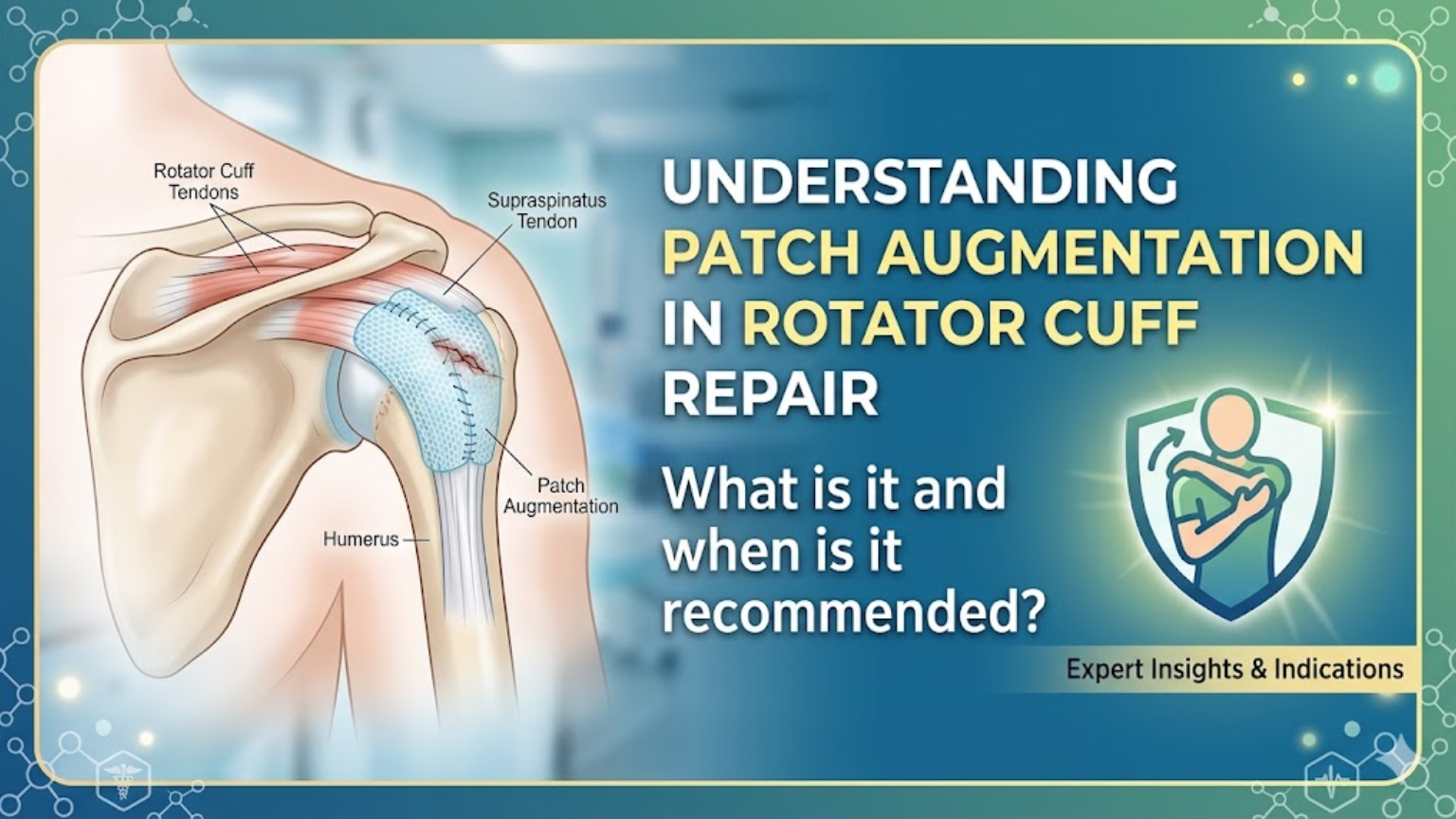
Shoulder pain due to rotator cuff tears can deteriorate your overall health condition. It might affect your hand mobility, limiting your daily movement. In most conditions, the tears affect the tendons that help stabilize your shoulder joint, in case of aging, trauma, or overuse. Several medical reports suggest that in case of dire conditions, standard surgical repair might fall short.
If you are suffering from advanced tear issues, patch augmentation rotator cuff surgery can help you recover perfectly over time. It’s a proven technique that restores strength and exponential healing of your shoulder.
We will discuss more about it in this article. But before you jump to conclusions, consult an expert. Let’s start, shall we?
What Is Patch Augmentation in Rotator Cuff Surgery
It is an advanced surgical technique designed specifically for you if your rotator cuff tear requires more than a basic repair. During the procedure, your surgeon will be using a graft or a patch to reinforce and augment the repair of a torn rotator cuff tendon. It is generally fixed on top of the repair with sutures or anchors to provide additional strength and support to the healing tissue.
This patch acts as reinforcement, distributing stress across the tendon and encouraging your body’s natural healing process. It’s seamlessly integrated into your surgery, often using minimally invasive tools to minimize your recovery time.
Why Patch Augmentation Is Used in Rotator Cuff Repair
Not all cases need rotator cuff repair with patch augmentation. Your orthopaedic surgeon will diagnose the tear first and then recommend, if required. And there are three main reasons why they recommend this type of surgery to patients:
- Strengthens the repair: It provides substantial mechanical support, preventing your tendon from pulling apart under regular strains.
- It aids in healing: the patch will help promote the generation of tissue and further stimulate blood supply to the area by providing access to growth factors.
- It decreases the possibility of subsequent tears: this option is especially important for individuals with high-risk tears, as it will decrease the failure rates of the repair and allow for a quick recovery of strength.
Consider this patch as in the case of steel cables to a bridge. It holds your rotator cuff to get that extra longevity it needs to balance.
When Is Patch Augmentation Recommended for Rotator Cuff Tears
Most orthopedic surgeons recommend this type of rotator cuff surgery only in cases that involve:
- Significantly sized tears (greater than 3 centimeters) that cannot be treated with traditional techniques.
- Aged patients with a bad tendon condition
- Already, surgery has been performed on the patient, and this is the second time
- The lifestyle of patients that revolving around heavy tasks or sports
Benefits of Patch Augmentation in Rotator Cuff Repair
The benefits of this kind of rotator cuff repair mainly indicate long-term impact: You gain:
- Increased strength of the tendon: Reports indicate there may be repairs that are up to 50% stronger than previously repaired tendons, with up to 30% less chance of being retorn.
- Faster healing time: The patch, in effect, acts as an extra biological unit. This will speed up how quickly your body can regrow tissue, and as a result, can often be completed in less time.
- Improved stability and function: You will have an excellent range of motion and will be able to use a greater amount of your strength for everyday things.
- Pain relief: You will not have any lingering pain after you have healed from your surgery, and you will have no trouble sleeping or resting.
And it’s nothing new. Patients with rotator cuff have reported returning to their hobbies and work life in no time.
Types of Patches Used in Rotator Cuff Surgery
Experienced surgeons select the ideal patch based on your tear’s specifics, ensuring biocompatibility and effectiveness. There are two main types:
- Biological patches: Derived from human or animal tissues (e.g., dermal allografts or xenografts). These are absorbable, integrating fully into your body over a span of 6-12 months. Simultaneously, they promote natural regeneration. Ideal for you if tendon healing is the priority.
- Synthetic patches: These are manufactured from sturdy materials like polyester mesh or polypropylene. These, being non-absorbable and permanent, offer mechanical leverage for the long term. Ideal for big tears or poor tissue quality.
Most surgeons discuss the good and the bad during the pre-operation phase. The suggestions are relative to your age, activity level, and anatomy for best results.
Recovery After Rotator Cuff Repair with Patch Augmentation
Recovery of patients after a successful shoulder patch augmentation surgery is pretty quick compared to other types. The journey somewhat goes like this:
- Immobilization (0-6 weeks): Patients are given a sling to protect the repair. Gentle free-hand exercises to be done upon consultation.
- Physiotherapy (6-12 weeks): At this stage, therapists guide patients from passive strength exercises to active ones gradually.
- Full activity (3-6 months): If things progress well, patients can return to a desk job after 3 months, and athletes can resume their practice sessions after 5 to 6 months.
If you are a patient who has just undergone the medical procedure, remember to consult your physician before progressing to each step.
Who Is a Candidate for Patch Augmentation
Rotator cuff tear patch augmentation is not for everyone who requires surgical intervention. It’s only ideal for:
- Those with substantial tears (greater than 3 cms) or multi-tendon involvement.
- Patients with degenerative, retracted, or fatty tendons.
- Individuals needing revision after failed repairs.
- Active adults, like athletes or those who play contact sports, seeking durable outcomes.
At the end of the day, it is not your call to identify your issue and claim your candidacy. Always go for a proper diagnosis from a healthcare centre and then make an informed decision.
Final Takeaway
Look, a patch augmentation rotator cuff surgery is recommended only to certain patients having special shoulder conditions. No doubt, it helps in quick tendon strengthening. Here, a patient needs a proper orthopaedic surgeon who can guide them throughout their procedure till their recovery.
If you are a patient, you need to start your treatment early. You don’t want more complications in your rotator cuff injury, do you? So, if you are still confused, book a consultation with Mumbai’s best orthopaedic surgeon today. How? Well, visit our platform, and you are all sorted.